Phones answered 24/7Phoenix, AZ 85003
Call (833) 490-5225
Urgent? Phones answered 24/7

Slab Leak Water Damage Cleanup in Phoenix

Drying floors, walls and slabs after a leak in the copper under the concrete, in Phoenix homes built when those lines went in.

  • Phones answered 24/7
  • Monsoon leaks, slab leaks, AC and cooler drips
  • Emergency price agreed before a hose comes off the truck
  • Meter readings and photographs you can hand your insurer

Get a fast quote

Fastest: call (833) 490-5225. Or send this and we call you back.

Slab Leaks

Slab Leak Water Damage: what it covers

Quick answer

A slab leak is a break in a water line buried in or under the concrete floor, so the water soaks the slab and rises into flooring, baseboard and walls. Phoenix Water Damage Restoration handles the cleanup and drying across Phoenix and Maricopa County, phones answered 24/7, while a licensed plumber locates and repairs the pipe.

Slab Leak Water Damage illustration for Phoenix, AZ

A slab leak rarely announces itself. The water has nowhere to go but into the concrete and sideways along it, so what you notice is a floor that feels warm in one spot, a bill that climbed for no reason, baseboard swelling in a hallway, or the faint sound of running water in a quiet house at night.

The reason these are so common here is simple arithmetic. Phoenix was an early adopter of slab-on-grade building, the post-war ranch neighborhoods laid copper supply lines in and under that concrete, and a house finished in the late 1950s has those lines pushing seventy years of service while carrying very hard water.

Two jobs follow, in this order. A plumber locates the leak and chooses a repair, which may mean breaking a small section of slab or re-routing the line overhead. The crew deals with the water: extraction, taking up flooring that will not dry, drying the slab itself and recording readings until they are back to normal.

Service area
Phoenix & Maricopa County
Availability
Phones answered 24/7, emergencies first
Typical cost
$1,200-$5,000 (estimate)
Warning signs

Signs you need slab leak water damage

If a floor is wet and you cannot find a source above it, do not start pulling up tile or cutting into the slab yourself: a buried line under pressure and buried electrical conduit are both in there. Keep off wet flooring near outlets and call (833) 490-5225 to get readings taken first.

  • One patch of floor that is noticeably warm, which usually means the hot-water line is the one leaking
  • The water meter's low-flow dial turning while every tap, toilet, irrigation valve and ice maker is off
  • A water bill that steps up and stays up, with no change in how the household uses water
  • The sound of running water under the floor when the house is quiet, often clearest at night
  • Grout darkening, tile lifting or laminate cupping in one area with no spill to explain it
  • Baseboard swelling or paint flaking along the bottom of a wall, often an interior wall
  • A damp or musty smell in a closet or along a hallway, and carpet that feels cool in one spot
  • Hot water pressure that drops, or a water heater that runs more than it used to
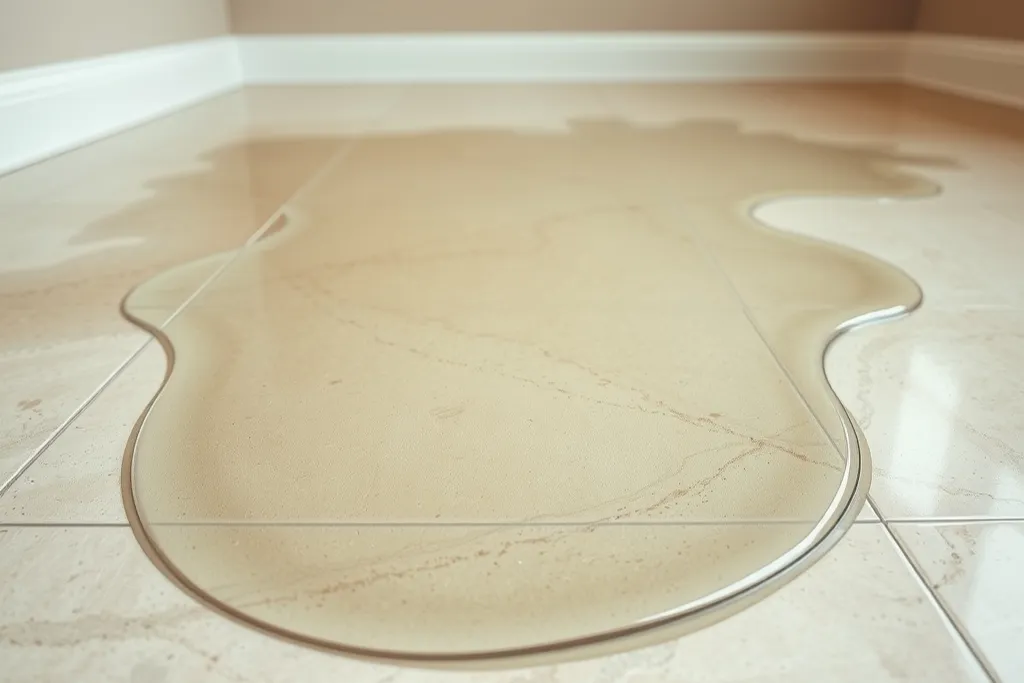
A thin sheet of clear water spreading across beige floor tile toward a white baseboard.
On a slab floor the water has nowhere to go but sideways, under the tile bed and into the wall base.Every photograph here is an illustration of the sort of building, damage or drying work described on the page, and none of them shows a loss restored by this business.
Our process

How our slab leak water damage visit works

  1. Confirm it is the slab, not something above it

    Before anyone breaks concrete, the crew rules out the obvious lookalikes: a shower pan, a toilet seal, a condensate line, an exterior irrigation break near the stem wall. Meter readings across the floor and a thermal scan show where the warm, wet area actually is.

  2. Hand the pipe to a plumber and keep drying moving

    Leak location and repair are plumbing work, and you are told that plainly. While the plumber schedules detection, the crew can shut the water, extract what is on the floor and set equipment, so the slab is not sitting wet for another two days.

  3. Lift the flooring that cannot be dried in place

    Carpet pad over a wet slab comes out. Laminate and engineered plank that has swelled is removed. Tile is often kept, with drying worked through the grout, but tile set on a saturated mortar bed sometimes has to come up to reach the concrete.

  4. Dry the concrete, not just the surface

    Drying mats are sealed to the floor and pulled under vacuum, with air movers and a dehumidifier working the room. Concrete gives up water slowly, so this is the stage that sets the schedule, and readings are taken at the same marked points every visit.

  5. Rebuild once the slab reads dry

    New flooring, baseboard, and any drywall or cabinet base that came out are quoted separately after the readings land. Flooring laid over a slab that is still releasing moisture will cup, lift or trap that moisture under the adhesive.

Cost

How much does slab leak water damage cost in Phoenix?

Cleanup pricing turns on how much floor got wet, what the flooring is and how many days the concrete needs. The plumber's detection and repair sit on a separate bill, and nothing in this table includes them.

Slab Leak Water Damage pricing in Maricopa County (2026)
JobTypical rangeWhat it includes
Slab leak water cleanup, one or two rooms$1,200-$5,000Extraction, wet flooring removal and drying; the plumber's slab repair is not included
Structural drying for one room (3-5 days, equipment and monitoring)$800-$2,500Mats, air movers, dehumidifier and the return visits to re-read
Air mover (per unit, per day)$25-$50Several run at once to keep air moving over the wet slab
Commercial dehumidifier, LGR (per unit, per day)$75-$150Removes the moisture the slab releases into the room
Wet carpet pad removal and disposal (per sq ft)$0.75-$2.00Pad over a wet slab is replaced rather than dried
Antimicrobial application (per sq ft)$0.50-$2.00Used where water sat under flooring long enough to need it

These ranges are the planning figures a crew works from for Maricopa County in 2026, not a published rate card, and a slab job in particular moves with how long the leak ran. You hear the emergency-stage price for your house before extraction starts, and flooring and repairs are quoted after the concrete reads dry.

Job stories

Typical jobs for slab leak water damage

Typical job
Illustration: A warm spot on an Alhambra tile floor turns out to be a slab leak

A warm spot on an Alhambra tile floor turns out to be a slab leak

What homeowners notice
A 1950s block house in Alhambra has a patch of hallway tile that feels warm underfoot, and the baseboard in the next room has started to swell. With every fixture in the house closed, the dial on the water meter is still turning, which points at a hot-water line in the slab rather than anything above the floor.
What we do
The homeowner closes the main while a licensed plumber is called to locate and repair the line. A technician traces how far the water has travelled with pin and pinless moisture meters and a thermal camera, lifts the loose tile and the swollen baseboard, cuts the drywall back where the meter still reads wet, and sets air movers with an LGR dehumidifier directed along the slab and into the open wall cavities. The plumber does the pipe repair on a separate visit.
What to expect
The slab, the mortar bed and the wall plates match the dry reference after several days of logged checks, and tile and baseboard replacement is quoted once the floor measures dry.

4–5 hours typical visit

How do I know it is a slab leak and not something else?

Two tests point at the slab. Turn off every fixture, appliance and irrigation valve, then watch the low-flow dial on your water meter: movement means water is escaping somewhere. A patch of floor that is warm with no radiant heating points at the hot-water line under the concrete.

Read the meter, write the number down and read it again an hour later with nothing running, including the ice maker and the pool auto-fill. A change confirms a leak but not its location, which is why detection equipment belongs to a plumber rather than to guesswork.

The lookalikes are worth eliminating first, because they are cheaper. A failed shower pan, a leaking toilet seal, an AC condensate line running inside a wall and an irrigation break just outside the stem wall all produce wet flooring in the middle of a room. The slab leak guide for Phoenix homes walks through sorting them out.

  • Meter moves with everything off: water is escaping somewhere on the property
  • Warm floor spot: usually the hot-water line under the slab
  • Wet only after a shower is used: more likely a pan or a drain than the slab
  • Wet near an exterior wall after the irrigation runs: look outside first

What happens to tile, wood and carpet over a wet slab?

Tile usually survives and can often be dried through the grout, though it takes longer than carpet. Carpet pad over wet concrete is replaced. Laminate, engineered plank and glued-down wood that absorbed moisture swells, cups or lifts at the seams and generally does not recover.

The slab is the reservoir, so flooring that seals the top of it works against drying. A sheet vinyl floor or a glued plank can hold moisture in the concrete for weeks, which is why some of it comes up to let the slab breathe even where the flooring itself looks acceptable.

If the floor is being replaced anyway, that is the moment to confirm the slab reads dry before adhesive goes down. Moisture pushing up through new flooring is one of the most expensive mistakes made after a slab leak, because the second installation is on you.

Why does a concrete slab take so long to dry?

Concrete is dense and holds water deep inside, so moisture leaves slowly and mostly through the surface. Industry guidance treats dense materials such as slabs and mortar beds as specialty drying, which means mats pulled under vacuum, more dehumidification and a longer schedule than drying carpet or drywall.

Desert air helps at the surface and does nothing about the inside of the concrete, which is the part that matters. A slab can read wet for days after the tile over it feels perfectly dry underfoot, and only a meter tells you which one you are looking at. Structural drying explains how those targets are set.

Monsoon weeks make it slower again, because the dehumidifier is working against a higher outdoor dew point as well as the slab.

Who repairs a slab leak, and what are the options?

A licensed plumber locates the leak and chooses the repair: breaking out a small section of concrete for a spot repair, or abandoning the buried section and re-routing the line through a wall or the attic. The restoration crew handles extraction, flooring removal, drying and documentation around that work.

Plumbers in the Valley report leak detection in the low hundreds of dollars, spot repairs commonly in the high hundreds to low thousands, and a full re-route running into several thousand or more, with a very wide overall spread. Get those numbers from the plumber for your own house; they are not part of the cleanup quote.

If concrete has to come out, expect dust and noise for a day and a patch in the slab afterward. Coordinate the two visits: the crew can be drying before the plumber starts and will often need to come back once the repair opening is closed.

  • Plumber: detection, spot repair, re-route or partial repipe, pressure testing
  • Restoration crew: extraction, wet flooring removal, slab and wall drying, readings and photos
  • Licensed contractor: new flooring, baseboard, drywall and cabinet repairs afterward
Options

Types and options for slab leak water damage

Hot-line leaks

The most frequently found type, and the easiest to notice, because the escaping water warms the concrete above it and leaves a patch you can feel through tile with a bare foot. A hot-side leak also makes the water heater cycle more often and can soften hot-water pressure.

Cold-line leaks

Harder to spot, since there is no warm patch to find. These usually show up as a meter that moves with the house shut off, a bill that will not come back down, or wet flooring and baseboard with no explanation. They can run a long time before anyone connects the symptoms.

Drain and sewer lines under the slab

Not every under-slab leak is a pressurized supply line. Older cast-iron and clay drain lines crack or separate, and tree roots find the joints. That water is contaminated rather than clean, which changes what can be saved: see sewage cleanup for the handling a Category 3 loss needs.

Maricopa County

Why slab leak water damage is different in Maricopa County

The post-war belt across central and west Phoenix is where most of these calls come from. Maryvale, started in 1954 as one of the country's first master-planned communities, Alhambra's small ranch homes built largely after the war, and Sunnyslope's 1950s houses all went up with copper in and under the slab, and that copper has carried hard water ever since.

The same era repeats outside city limits. Arcadia's ranch houses on old citrus-grove lots date from the 1950s and 1960s, Tempe surveyed roughly 4,500 homes built between 1945 and 1960 in neighborhoods such as Borden Homes and Date Palm Manor, central Mesa and Glendale are mostly mid-century single-story houses, and Sun City's small slab homes have been in use since Del Webb opened it in 1960.

Ground conditions get blamed too. Valley soils are desert alluvium with hard caliche layers and pockets of clay, and movement in that ground is often cited as a stress on lines buried under a slab. Add big single-level floor plans and continuous tile, as in Arcadia and Moon Valley, and one buried pinhole can wet a long run of floor before anybody notices.

Skip the guesswork. Call for a straight answer.

Tell us what's happening and we'll tell you honestly whether it's a quick fix, and what slab leak water damage should cost.

Related

Burst Pipe Water Damage

Cleanup and drying after a supply line lets go, from copper pinholes in older Phoenix homes to split fittings in attics and exterior walls.

Structural Drying

Air movers, LGR dehumidifiers and daily meter readings that take a slab, tile bed, wall or ceiling to a documented dry goal.

Water Damage Restoration

Moisture mapping, water removal, metered drying and after-drying repair for homes and businesses across Phoenix and the Valley.

Mold Inspection

A visual and moisture-mapping inspection that ties what you can smell or see to the leak behind it, with the readings written down.

Guides

Read before you book

FAQ

Slab Leak Water Damage FAQs

Does the whole floor have to come up?

Usually not. The plumber opens only the small area needed for the repair, or avoids the slab entirely by re-routing the line. The crew removes flooring where readings say the material underneath cannot dry through it, which is often a part of one or two rooms rather than a whole house.

My water bill doubled but I cannot see any wet floor. Is that possible?

Yes, and it is common. Water escaping under a slab can travel through the ground or out past the stem wall without ever surfacing indoors, especially on a cold-water line. A meter test with the house shut off will tell you whether water is leaving the system, and a plumber can locate it from there.

Will a slab leak cause mold?

It can, if the water reaches organic materials and stays there: carpet pad, baseboard, the paper facing on drywall and cabinet particleboard. Bare concrete and tile themselves do not feed mold. Getting those wet materials out and the slab dried to a reading is what keeps it from becoming a second job.

Is a slab leak covered by homeowners insurance in Arizona?

Policies often cover the sudden and accidental damage water does to the house, while the cost of digging up and fixing the pipe is frequently treated differently, and a leak that ran for months may be called seepage and excluded. Your insurer decides under your policy, so call your agent before work goes far.

Can you dry the slab without removing the tile?

Often, yes. Mats are sealed to the tile surface and pull moisture up through the grout under vacuum, which works well when the mortar bed is damp rather than saturated. Where the bed itself is soaked, removing a section of tile is the faster route and ends up costing less in drying days.

How long will the equipment be in my house?

Plan on several days for a single room and longer where the slab was wet for a while, because concrete releases moisture slowly. The crew re-reads the same marked points each visit, and the equipment comes out when those readings match a dry reference elsewhere in your house.

Should I repipe the whole house after one slab leak?

That is a plumber's call, based on pipe condition, water pressure and whether you have had failures before. Plenty of Valley homeowners repair the first leak and re-route after a second one. It is not restoration work, and no decision like that needs to be made while the floor is still wet.

Find Phoenix Water Damage Restoration on